
 Black
Black Blue
Blue Brown
Brown Green
Green Grey
Grey Mixed
Mixed Orange
 Neutral
 Purple
 Red
Red Yellow
carpet tiles
What size are carpet tiles?
Nov
Carpet tiles are a popular flooring solution across a range of sectors, including commercial, educational, and residential environments. Their modular format, ease of installation, and design flexibility make them an appealing alternative to traditional carpet and other flooring options. However, for anyone specifying flooring for the first time, one frequently asked question is: what size are carpet tiles?
Although there are common industry standards, the answer is not entirely straightforward. Carpet tiles come in a variety of dimensions, shapes, and formats designed to accommodate different design intentions, performance requirements, and installation methods. Understanding these sizes, and why manufacturers offer them, can make the specification process far smoother.
What is the most common carpet tile size? Answer: 50 x 50 cm
The standard and most widely used carpet tile size across the global market is 50 x 50 cm (equivalent to roughly 19.7 x 19.7 inches). This square format became the industry norm because it provides the right balance between handling convenience, installation speed, and modular flexibility.
A 50 x 50 cm tile is easy to lift, lay, replace, and store. It works well with typical room dimensions, allows for straightforward cutting around edges and fixtures, and promotes design consistency. Most major commercial carpet tile ranges, whether loop pile, cut pile, or textured, are manufactured in this format.
Why the 50 x 50 cm format dominates
There are several reasons why this particular size has remained the standard for decades:
- Modularity: Tiles fit neatly into grids and allow for the easy creation of patterns such as quarter-turn, monolithic, brick, or ashlar.
- Efficiency: Smaller tiles reduce waste during installation, particularly in irregular spaces.
- Ease of handling: Installers can carry and place the tiles comfortably, reducing fatigue.
- Maintenance advantages: Damaged tiles can be swapped out individually without disrupting large areas.
- Stocking and logistics: The size makes transportation and storage more efficient for both suppliers and end-users.
Despite the popularity of 50 x 50 cm tiles, the market has diversified significantly, especially as design trends and modular flooring technologies have evolved.
What are the other common carpet tile sizes?
Manufacturers now offer a broader selection of dimensions to support more creative layouts, improve acoustic properties, or replicate alternative flooring types. Some of the most common options include:
25 x 100 cm (Planks)
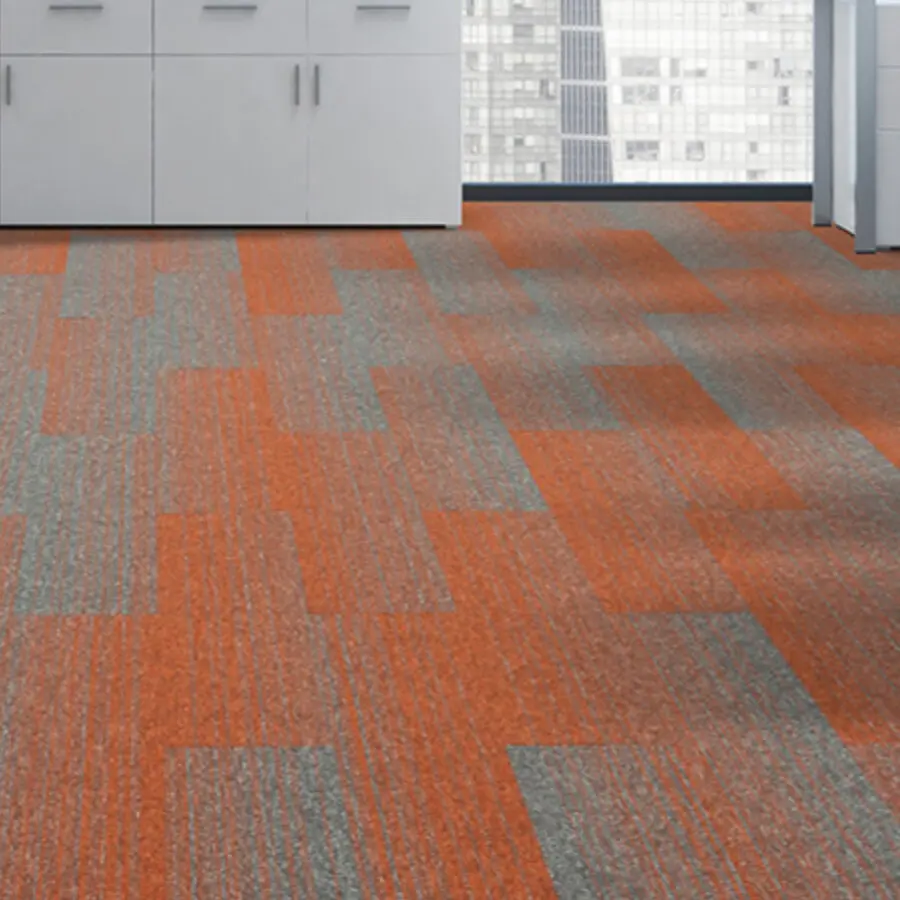
Carpet planks have surged in popularity, particularly in contemporary office and hospitality environments. A common size is 25 x 100 cm, giving designers the ability to mimic the appearance of timber flooring or to create directional patterns such as herringbone or chevron. Planks are effective when blending colours or textures to create transitions between zones.
50 x 100 cm
This larger rectangular format offers many of the same design opportunities as 25 x 100 cm planks while delivering a broader surface area. It can be used to elongate spaces visually or create subtle directional flow.
60 x 60 cm
Although less common, some premium or specialist ranges are available in 60 x 60 cm tiles. These tend to be used in high-end commercial settings or for deeper textures that benefit from a slightly larger module.
1 m x 1 m
Large format carpet tiles, typically 100 x 100 cm, are used in settings where a more seamless look is desired without fully committing to broadloom. They can reduce the number of joints and offer a clean, more expansive aesthetic. This size is also favoured in some heavy-duty or industrial applications.
What about different carpet tile shapes?
While most tiles are square or plank-shaped, innovation in the sector has led to the introduction of more unusual shapes, including:
- Hexagons
- Triangles
- Rhombus and diamond formats
These shapes are mainly used for design-led interiors where striking patterns or multi-directional layouts are required. Although they create visually distinctive flooring, they may require more careful installation planning and sometimes result in slightly higher waste percentages.
Choosing the right carpet tile size for your project?
Selecting the appropriate carpet tile size depends on several factors, including:
- Aesthetic goals: Planks and large-format tiles can visually lengthen or widen a room, making them useful in narrow corridors or expansive open-plan areas. Smaller square tiles offer more traditional or uniform designs, ideal for corporate settings where consistency is key.
- Practical considerations: Smaller tiles are easier to handle in tight spaces or around fitted furniture. Larger tiles reduce the total number of joints, which may improve the perceived smoothness of the floor.
- Acoustic performance: Different tile sizes can influence how a space feels acoustically. Larger tiles often support heavier backings and provide enhanced sound absorption, although the overall performance also depends heavily on material and construction.
- Installation method: Most carpet tiles are installed using a pressure-sensitive adhesive or tackifier. However, some specialist formats, especially larger tiles, may require more specific installation guidance. Plank-shaped tiles can also require more planning to ensure pattern alignment.
- Maintenance strategy: If your aim is to replace damaged tiles quickly with minimal disruption, smaller modules like 50 x 50 cm can be more convenient. In busy commercial environments, this modularity is a key advantage.
So what size are carpet tiles?
There is no single answer to the question of what size carpet tiles come in, although 50 x 50 cm remains the foundational standard across the industry. From practical planks to bold geometric shapes, there are a number of options to suit various design, performance, and maintenance requirements.
For a variety of office carpet tile options, Discount Carpet Tiles are the team for you. We stock more than 500,000 carpet tiles for you to choose from, so you are sure to find the perfect option for your workspace. Why not take a look today?